Monday, October 19, 2015

yo girl gets pUblished

Here--->               http://www.3ammagazine.com/3am/sarahsimon/
yes i am making you copy and paste it in that iconic strip

enervated like Malaspina by the honor.

Other work on the 3AM site that I just think is great:

animals & other poems
ANIMALS
In Blankets

They take their turns placing dumbbells on top of one another, to keep reminded: these dreamlike qualities of rooms are ones of prevarication. The plumy way in which his dipper lip blooms up the word ‘wonderful’ wins her over: she buries a white nose beneath his ear.

Thursday, October 8, 2015

do your little bit//not food related\\a definitely food-related challenge

"Do your little bit of good wherever you are; it's those little bits of good put together that overwhelm the world." ~Desmond Tutu

Can you tell I copy and pasted the above from a PowerPoint>

Well. I'm going to do my little bit of good right now. 

And it's funny what we decide to be "good"; the term is subjective, left to contingencies, spliced on situational dependencies.


Can you think of something that seems to be "good" in your life right now that, at other times, hasn't been so good?

coats, for instance.

Because I began this thing with claims that it was and would forever be a food blog, for the first time in a battery of posts, I'm going to be discussing food.

Here's an instance I can picture now, where the "good" is entirely reliant on disposition or situation. Look at this:


This is my left hand, holding a jar of cashew butter in a health food store. My right hand is busy documenting what my left hand is doing.

In my opinion then, and in my opinion now, this jar of cashew butter is good. But what if I was severely allergic to cashews? Or take this:


A turkey, stuffed to the brim by my father (whose hand I physically impeded from additional stuffing action). This image, while it was taken, reflected something I thought was good. Half an hour later, a picture of food was the last thing I wished to see. 

One last one, not food related:

or I hope you don't consider it food related. That's not good.


When posing for this high school prom picture, I didn't consider the act particularly good or bad. I remember feeling a dullness that I thought should resemble excitement.


Now, I look back on prom and I think it was pretty good.


Anyway, speaking of good. I hope my ostensible displays of culinary mediocrity will inspire a little somethin' in your kitchen.


make it good.

Credit for this pie goes to Mehdi, who made it without following a recipe.

And so I challenge you. Make a pie. Don't measure anything.

See how it turns out.

Maybe your expression will resemble his.

Monday, September 28, 2015

trying to understand the economy with sarah simon

I have decided to write a post on the economy, given all this recent hubbub.
I'm like, what's going on?
ARE WE GOING TO CRASH
IS THIS 1929
IS THIS 2008
AM I GOING TO HAVE A JOB WHEN I GRADUATE COLLEGE?

I think a good thing to do–before we grab a paper bag and recreate the hyperventilation dramatized in sitcoms–is to try and understand the root of the issue.

For an informative video introduction, watch this: https://www.youtube.com/watch?v=h4Ns4ltUvfw

A SUMMARY

"real money and promises about money go back and forth; it's called CREDIT"

REMEMBER that teeter-totter analogy at the beginning of the video? Economically, we are all at the playground, riding that thing. In other words, we are contributing what we can to keep the economy going!

This is the glorious idea of untainted capitalism. 

The theory of capitalism is beautiful: it boasts an economic system in which everyone is giving money and taking money at different times, contributing to HOMEOSTASIS.

Like any ecosystem or body: IT'S A BALANCING ACT. You sleep and you are awake; you give money and you receive money.

Ever hear that capitalistic axiom, "you gotta spend money to make money?"
The idea is, you need to be out in order to be in.

THINK OF YOUR MOODS: could you ever feel AS HAPPY AS YOU DO SEEING SARAH POSTED ON HER BLOG TODAY if you didn't experience the despair you do WHEN SARAH DOESN'T POST?

Similar to capitalistic theory, you can't know happiness without sadness.

~~i declare my narcissistic episode done now~~

Given this exhaustive theoretical description, I wish to never hear an uninformed rebuff of capitalism. Capitalism promotes ideas we all ought to remind ourselves of, such as BALANCE.

but you don't have to show it off all the time.

Keep balance on the mind as we teeter.

(1) FIRST WAY A CAPITALISTIC ECONOMY OSCILLATES: HOUSE-BUYING

People buy houses and want to live in them as soon as possible. However, most house buyers can't possibly pay the entire price of the house at one time, so they set up a deal with the bank (which owns the house) also known as a mortgage or IOU.
IOU is literally "I owe you." Haha.

The mortgage is created when the bank pays the balance on the house that the house buyers did not pay. Therefore, the house buyers now owe the bank money.

Mortgages allow house buyers to pay back what the bank loaned out over a period of time.
For many buyers, this is a sustainable method of payment. 

Having the money to loan out is called DEPOSITORY BANKING, because banks need large sums, or deposits of money, in order to lend money.

But what do the banks get out of this? 
When entering into a mortgage, you agree to interest on that mortgage, or little fixed sums that you pay back to the bank in addition to the original amount that is owed (i.e. the price of the house). This goes back to the idea of balance: You lucky house-buyer take money now, but are expected to pay that–and then some–later.

The teeter-totter: In the long run, banks receive more money than they lent out. To make money, you must spend money.

(2) SECOND WAY A CAPITALISTIC ECONOMY OSCILLATES: BUSINESSES

People have ideas and think they're so good that they want to make money off of their ideas.

bet you haven't seen a meme in a while.

To make money, these innovative people start businesses. But to start a business–invest in a big capitalistic endeavor much like buying a house–you have to make promises.

The promises business starters make are similar to the promises house buyers make. As a bank invests in a house, expecting the house-buyer to pay back the remaining sum and then some more through a mortgage, an investor invests in a person's idea for a business, expecting to share in that innovator's anticipated profit.

Let's pretend I am trying to sell a new Toothpaste that I believe is superior to both Crest and Colgate.

haha, the SECOND meme you have seen it a while. it's a productive day for you.

The above meme illustrates the complex, world-bending issue many tooth-enthusiasts face. My product, TeethPaste, however, will eliminate the problem; it is both grammatically correct ("tooth" paste is singular–what's with that?) and effective at eliminating bad breath.

"I'll make money soon with TeethPaste! But hey, in order to get started and promote my product, I need money from you, dear investor. If you fund me now, I'll promise to reimburse you and then some with the profit I'll eventually reap." 

The promise I make as an advocate of TeethPaste is called a security. You invest in me now, and I secure you hold on future profit.

TO QUICKLY SUMMARIZE

DEPOSITORY BANKS (house-buyer deals): SELL MONEY FOR PROMISES
I will give you money now and you promise to return it and more to me later.

INVESTMENT BANKS (business deals): SELL PROMISES FOR MONEY
I will promise you a percentage of my company's profit if you give me money now.

This all seems orderly and good. So what's the big deal? What's the controversy of capitalism?

In 1999, the GLASS-STEGALL ACT, which separated Depository from Investment Banks, was repealed and replaced by the fancy-shmancy "Financial Service Modernization Act"

"This connected depository activities with investment activities"
oh yeah, cuz we're modern now and everything

EVENTS THAT FOLLOWED

MORTGAGES were now sold to investors, WHO EXPECTED TO MAKE MONEY ON WHAT ONLY THE DEPOSITORY BANKS USED TO BE ABLE TO: "mortgage-backed securities"

THE GOVERNMENT started helping people buy houses, creating the "housing boom"

The BOOM, or rapid increase in house sales, involved people who normally wouldn't have been allowed to purchase houses suddenly purchasing houses.

To be allowed to buy a house, one usually went through background checks. In the case of faulty credit score, low income, or whatever indicator that pointed to the risk the person not being able to pay his or her mortgage, some were barred from house-buying.

During the boom, LESS ATTENTION was given to background checks, so people who were very likely to NEVER BE ABLE TO PAY THEIR MORTGAGE IN FULL were expected to.
Why were these risky investments allowed?
Quick money for investors. 

Since demand for houses increased during the boom, the supply, along with the price, of houses increased. Investors saw this as an opportunity to profit off a lucrative market.

But when there's an up, there's always a–

Recall Balance.

As you probably expected, with all these risky investments made in doubtful mortgage deals, people defaulted, or failed to pay back on their loans.

When people default on their mortgages, their houses foreclose. When foreclosure really picked up following the boom, there were too many houses and not enough people to live in them. So, house price drops. The supply of fancy houses is exceeding the demand of fancy houses.

Now, houses suddenly became not worth as much as their corresponding LONG-TERM mortgage payments (PEOPLE COULDN'T PAY BACK THEIR PROMISES) so the banks tried to quell investors' woes by using their own deposits.
its deposits?

THE MONEY YOU AND I KEEP IN OUR BANKS THAT WE THINK IS SO SAFE AND CUDDLY IS USED FOR THINGS

I used to think that the money I kept in my bank account went untouched. But no honey, that isn't the case. We keep money in the bank for beautiful capitalism–spending money to make money. The price you pay for keeping your money safe is the bank's ability to use it.

No wonder when the economy goes up, you gain a little extra money in your account. But when it goes down, you lose some.

So, what happened in the 2008 financial crisis? The banks really had to use its deposits to pay back private investors who muddled up the capitalistic theory in order to make quick money and get rich.

Now i sound as cynical as my father. But that's what happened.
My father's pretty wise, I think. I make fun of hi for being a geezer but he's pretty keen on these subjects.

In recovery from economic failure, what happens? The government holds a lot of responsibility:

help banks, investors, or people?


"How do we fix this, and restore responsible balance between money and promises?"


TeethPaste.


P.S. many of these concepts can be hard to understand; I know I don't fully understand them; here's another video that may be of some financial aid:

Thursday, September 17, 2015

not so soft hon//ny

YOU START A DAY AND IT IS AGONY.

you think more, you ruminate, chew the cud of yourself.

GEE, why am i so unfortunate? why did I get myself into all these THING
S

THESE                 THINNGGGGS


yes.

Rushing rushing rushing now to a motorcycle accident
one    of the first days of your photography internship

ORIGINALLY commissioned to walk around a nearby campus, gathering images of overgrowing weeds.
o v e r g r oo ooo w ing

Your partner, who remarks at plants and burning bushes--at first you think he is convinced of theophany. 

Oh look, it's a burning bush!
giggle with a knowing giggle to vibrate social cues.
you don't know how to identify the bush he's referencing at all until

he sees another one, this time POINTING OUT the SPECIFIC CHARACTERISTICS:

LESS LIKE THIS

this was it.

And I laugh at my prior minutes musing on Moses and I think he may be Moses but really he just is very familiar with horticulture. He worked in a nursery.

Oh, like, the plant one. Not babies.

And we're tumbling on weeds and taking photos because THAT ANGLE when on your knees my GOD

he gets a call: okay, motorcycle accident at the meeting of South Street and Mary Jemison Drive.
Cuylerville Road, which turns into 39.

it was hard, but not as hard as I thought.

Ethereal, Oil on Canvas by Simon Kenny

The man on the motorcycle must have been unconscious during our first 15 minutes there; I didn't hear a word from him. Paramedics were sharp in their hovering.
I say sharp because they were not merely hovering, like
we
were. They seemed to be running by a script, but they were moving. With notebooks and pens, Moses and I shared a Canon, still; moving enough just to click.

I felt myself very much INSIDE yet ON THE FRINGES OF the PHOTOJOURNALISTIC DILEMMA; the ethics that sucking teeth question in front of journalists; I was now that object but I didn't feel so ridiculed or so w r ooo o ng.
It was not so wrong. But
feeling sedentary in the emergency 
your knees not dancing to the sirens were filthy 
cacophonies

Moses was calm; everyone was calm. Chiefs and sheriffs waved to him--they respected his work. As the newest extension of the publication I felt accepted from a distance. WE were sharing something, after all; HUMMING,to the moment of impact in its debris. 

The dent in the front left of the truck provided overture
And oh god so did his screaming when he woke up
That was when i felt it appropriate to say Oh God and feel it
and I felt it 
but also clam

He screamed "get me out of here!":
patches and shots on the asphalt.

A woman had been there up to that point, removing her shirt to mend open skin GET ME OUT
OF HERE!

She lost her car key on the way, running.

I saw her searching for it and followed her, thinking I might ask her a couple of questions regarding the EVENT, EVEN get a quote.

But we just roved around, our heads down.  She told me it was o.k.
I didn't have to keep looking.

My god she was calm in all this, even after stripping her gray sweaty t-shirt in front of small town safety officials for a motorcyclist she was on the way to see;
she was on the way to see him.

seeing other's agony, hearing it.
get me out of here 
get me out of here get me 
out.

it removes whatever started today's own.

AND NOT BECAUSE I WAS comparing
I was not giggling smiling snapping misfortune contests

the call away from theophanies was just enough to remind that your hair is not burning at all

Wednesday, September 9, 2015

czech phrases//from a time i made beautiful eggs//cover with a lid?

After travelling to the Czech Republic this summer, I assuage withdrawal with Czech phrases.

And enjoy overplaying how much I miss a location.

Actually, I'm glad to be wherever I am--that is, whatever physical location. But that doesn't mean my life is divided into eras, though it can feel that way.

I'd like to fluidify things--starting with that word.

~~~~~~~~~~~~~~~~~~~~~~~

Czech phrases

TERMS OF ENDEARMENT
Jsi krásná --you're beautiful
Nemám prítele --I don't have a boyfriend.
láska --love

NAVIGATION
ulice —street
Karlova—Charles
Karluv most —Charles Bridge
řeka —river
námĕstÍ —square (like town square)
hrad —castle

LITTLE BIG WORDS
ano --yes
ne --no
prosím --please
S dovolením --Excuse me
Prominte --I'm sorry
Dêkuji --Thank you.

EATING OUT
Zaplatíme! --check plz
Na zdraví --Cheers!
káva --coffee
beer --pivo

COMMUNICATION
Jak se máte? --How are you?
Jsem z Kanady --I am from Canada.
Mluvíte anglicky? --Do you speak eng
Mluvím jen trochu česky--I speak only a little Czech.
Nerozumím --I don't understand
Jak se rekne česky...? --how do you say ... in Czech?
Rád jsem vás poznal --it was nice meeting you.

DOG COMMANDS

Aport! --Fetch!

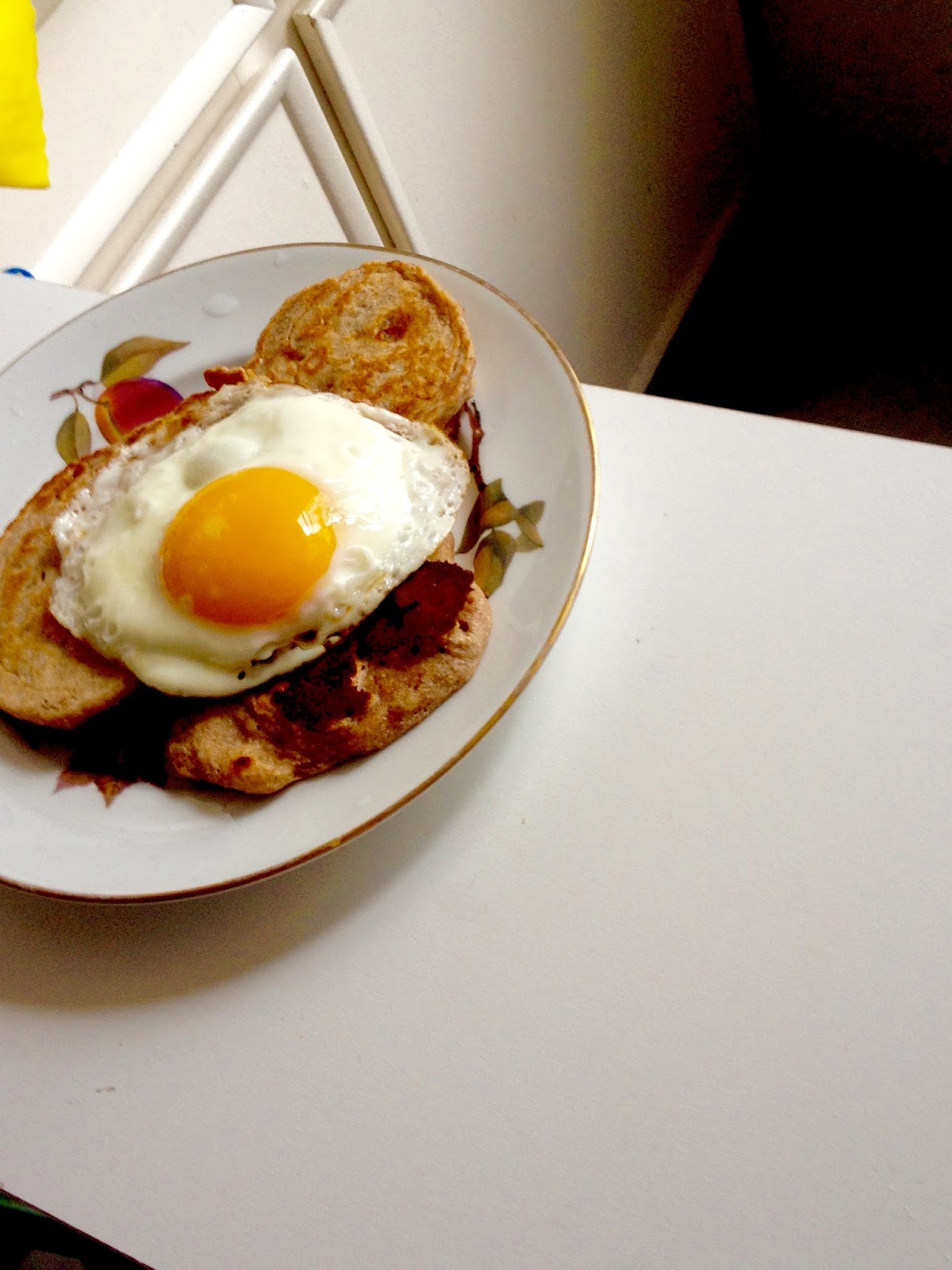
And here is media of an egg:

Eggs as garnish on pancakes. Recommended.

pancakes 

egg made reservations


again, sorry is yolks disgust you.


i edited this photograph to make the yolk look yellower than it was in actuality


To expand on my "eggs as pancake garnish" tip, I'd like to extend a question to you: How do you make the "perfect" sunny-side-up egg? Keep in mind, this is a form-specific question.

For example, I fry eggs with a lid on top--makes the yolk desirably runny, in my opinion. Recommended.

Thursday, September 3, 2015

murakami//orion's belt//flour to baking powder ratio

"Every great work of literature must at least allude to that great unknown, the meaning of life."

The above quote is taken from the great Book Slut site.

Haruki Murakami has been lauded as a contemporary narrational genius. His story telling abilities are in themselves, paradoxical; he interweaves symbol after sign in his aptly-named Chronicles, yet manages simplicity, an aura of uncomplicated-ness floating above roaring unknowns. 

After my introduction to Murakami and his work, through The Wind-Up Bird Chronicle, I am fine setting down the thick volume without understanding plot specifics. I am fine with convolution. 

Reading his work is like watching water without knowing why or how it runs. 


Wind-Up Bird does, on many occasions, hint "to the great unknown," which I often enjoy. I like alluding to things that we know are they but can't say. Murakami must say something, though; he is writing a book. In turn, he fills an upwards of 600 pages with uncomplicated language. He tells of a man who cooks pasta.

The unimportance is the urgency here; Book Slut writes, "You’ll never take for granted the ordinariness of spaghetti or your wife’s cat ever again."

Anyway, I recommend Murakami like it was recommended to me. Setting its meaning in context, Wind-Up demonstrates the influence of globalization on modern literature. There are references to Allen Ginsberg, for water's sake. 

I feel like I just cracked a joke about the plot line but still am unsure if that makes sense because, again, water is a symbol for something but I'm not quite sure what.

Murakami apparently doesn't plan out his stories, and lets his writing guide the story. Through the vignettes and history lessons, he still retains some sense of order. Like water.

And now I am thinking of Tinder.

I tried it out this summer.

IT IS SO FUNNY how two worlds just know something and spell it out in provocations.


What do we pick up on that carries two individuals through a conversation? You could say words.

Like the order of things, this tide of Tinder buzzes is obviously leading somewhere. But I never met the guy who orchestrated the gray bubble; I just wanted this to go at the time I was feeling it could and even that it should so it did because I let it.

The order of things.

By the way, for every pound of flour, add a TSP of baking powder and 1/4 TSP of salt for tasteful leavening. 

Sunday, August 23, 2015

inside/out/food

NOTE: This post about Disney-Pixar's Inside Out contains spoilers.


About a week ago, I traveled to Nebraska to visit family. As a tradition, we always go to the movies together. 

catch the flicks
see the sights

Even the twenty-five-year-old in our cousin bunch was set on Disney/Pixar’s latest production, Inside Out; even the twenty-five-year-old pleaded for tissues by the end, a popcorn bag becoming ersatz Kleenex. 


As the studio conglomerate’s first psychology-conscious film, Inside Out embraces the complexity of everyday emotions—especially those experienced by a pre-teen unaware of impending puberty. The movie’s psychoanalysis—sans a Freudian couch—begins with a zooming in on the characters’ head-quarters, or brain. Inside, five key emotions hover over a control board, waiting for a turn to govern it. In Riley Andersen, the eleven-year-old protagonist, Joy is often at the helm. 

she's the blue-haired pixie-lookin thang up above, but if you don't recognize that, I suggest watching the freakin film

Throughout Riley’s mid-pre-life crisis, she experiences a whirlwind of emotions, to be expected. Her coming-of-age is nonetheless heartwarming, but what my own analysis of psychoanalysis centered on was the portrayal of Joy; she’s yellow and glowing, donning a summery green dress. She’s often jumping about and smiling, marveling at Riley’s experiences, playing Dr. Pangloss at the unfortunate ones. But she has blue hair. In fact, her pixie do is the same shade of Sadness’ hair, who is completely blue. The very tip of Joy is Sadness.

After mulling over emotional complexity in a cavernous G-rated theater, I went home and searched Reddit.


As usual, the a forum pushed me even further:

Question: “Since Joy has blue hair, does that mean that there is a little bit of sadness in joy?”

The user with the greatest evidence of family movie-brooding is rewarded to SunshineAndGoldfish: 

I think you might be on to something. If we take it a step further...

Joy's Colors: Yellow body- Joy Blue Hair/Eyes/Eyebrows/Flowers on Dress- Sadness Green dress- Disgust Red Tongue- Anger Purple Lips- Fear
For extra credit:
Disgust has Purple lips, scarf and shoes. I am having a hard time telling if her tongue is Purple too or Pink/Red.
Anger has Yellow flames, Purpleish pants and it looks like the zig-zag of his tie has a Blue tint to it (possible Green).
Fear has Blue stripes on his sleeves and a Red tongue
Sadness has Purple glasses and a Red Tongue


Self-titled Disney/Pixar Fans deserve some sort of credibility, and so do their own answers:


I would also argue that the blue hair symbolizes that the two share a special connection. A huge theme in the movie is that emotions are not single shades but rather a mixture. This is most notable in that without Sadness, we cannot properly appreciate Joy.... Both as characters and as emotions.


Rabbi Geoffrey A. Mitelman expands on the question, relating it to Jewish philosophy: There is no such thing as “pure joy.” Happiness is borne by sadness.

(click on the photo for a debate on the subject)


Rabbi Mitelman includes a snippet of a New York Times review:

"The movie suggests that the bittersweet is a step up from untarnished joy and shows how frantic cheerfulness can stand in the way of genuine connection."

With that said, Joy would look terrifying without a little sadness anyway:


as for food, make an egg. poached