Monday, February 1, 2016

quotes//february//love

“February is a suitable month for dying. Everything around is dead, the trees black and frozen so that the appearance of green shoots two months hence seems preposterous, the ground hard and cold, the snow dirty, the winter hateful, hanging on too long.” 
― Anna Quindlen

this one is good too:


February makes a bridge and March breaks it.

Sunday, January 24, 2016

A concise//explanation as to why the economy and your body need to be the same

Reading not only helps you think differently, but, on particularly clarifying occasions, it leads you to feel as though conceptual nerve endings have cohered within three pages.

Red doesn't scare me.

Mr. Chang–professor of Economics at the University of Cambridge–wittily organizes his selected arguments about capitalism into 23 "Things." Chapters progress by "Thing #"

Thing 1, Thing 2, Thing 3...

Each chapter name, or "Thing #," is followed by an argumentative sentence, summing the analyses that subsequently unfold. For instance, Mr. Chang includes the almost curt yet possibly alluring

Most people in rich countries are paid more than they should be (Thing 3)
Assume the worst about people and you get the worst (Thing 5)
Free-market policies rarely make poor countries rich (Thing 7)
More education in itself is not going to make a country richer (Thing 17)
Despite the fall of communism, we are still living in planned economies (Thing 19)

Kirkus Review says 23 Things "Shak[es] Economics 101 assumptions to the core." I feel grateful to have been suggested the book by a professor of Sociology 102.

I'm majoring in psychology, so I think a great deal about people. Naturally, I relate Chang's recurring points to my studies of the mind.

here we go.


Why the economy needs to be exactly like you

Scribbles of a purple sticky note, transposed:

General take-aways

-What is better for the economy regulates productivity for the long term.
-There hasn't been enough investing for the long-term (GM, a good e.g.; 195)


Redirect your attention to the hovering cookie. I did not include the pastry nor the recognizable "KS" of the Starbucks logo for aesthetic effect, but to visualize my point. If regulation benefits the economy, the human body can be used for comparison.


This cookie. This cookie was really good. I think it's a new type of those mass-produced Starbucks goodies, and it's good. (I don't say "mass-produced" with scorn, because how else could we feed all these people if we didn't mechanize some expedited easy-bake oven?!?)

Back to the cookie–"Toffeedoodle," it's called. I highly recommend it–a blend of cinnamon and sugar, using toffee pieces as the chocolate chunks consumers might be hankering after in a cookie. And these toffee pieces–they offer the salt. In concert with market enthusiasm for blends of sweet and salty, such as caramel sea salt and chocolate-covered pretzels, this Toffeedoodle pleases.


While reading the above description, you might feel hungry. After clicking on phrases like caramel sea salt and chocolate-covered pretzels, you might feel like you could eat an entire bag of halloween-sized Take 5 bars. But that wouldn't be good for you in the morning.

OF COURSE I wanted to eat all of it immediately; I watched the barista transfer the Toffeedoodle to her comrade, and listened for her comrade to rustle it into the patented paper bag. I wanted to get that instant gratification. and when I finished it, I wanted more.

But then I waited–sometimes, my body needs to catch up. What did I just do? I ate a cookie. Do I need another one? Could I even take another one? Maybe. 

As it turns out, I neither needed nor could take another one today.

What is regulating my cookie-eating activity here? My mind.
What regulates economy? Regulations.

In the words of Mr. Chang: "Sometimes regulations help business by limiting the ability of firms to engage in activities that bring them greater profits in the short run but ultimately destroy the common resource that all business firms need" (197).

So, in simple terms, if my mind did not regulate my cookie-eating behavior, you, blog-reader, would never have any cookies ever again.

On to Chang's examples. They avoid the mental image of Sarah Simon ransacking your cookie jars:


Fish farming: "regulating the intensity of fish farming may reduce the profits of individual fish farms but help the fish-farming industry as a whole by preserving the quality of water that all fish farms have to use."

Child labor: "it may be of interest of individual firms to employ children and lower their wage bills. However, a widespread use of child labor will lower the quality of the labor force in the longer run by stunting the physical and mental development of children."

THE 2008 FINANCIAL CRISIS: "Individual banks may benefit from lending more aggressively. But when all of them do the same, they may suffer in the end, as such lending behaviors may increase the chance of a systemic collapse."

Restricting banks and businesses may force them to act in the interest of the long-run. What do you to to preserve yourself for tomorrow?

My mama always said: honey, it's balance. And balance is easy to say, easy to recommend, easy to see the benefit of. But it's as if our survival depends on the ability to resist the flight of bodies and minds, and stay grounded. Restriction might bum out the individual, but it's in the collective interest:


So, Marx, why didn't the Soviets succeed? Because PEOPLE NEED TO FEEL LIKE THEY OWN SOMETHING. So let me have this cookie. Just regulate me in the act of eating it.

Communism has failed for the same reasons unregulated capitalism has ruined lives: These systems do not operate in accordance with the body. The former assumes us unselfish; the latter assumes us rational. We are neither one nor the other all the time. So how can an economy, a collective pooling of our interests, constantly be what we are not constantly, and succeed?

The only way humans would thrive in a completely centrally-planned or utterly unregulated economy would be if Dr. Walter Freeman II were resurrected and we all begged him for transorbital lobotomies.

The Dr. does have a sparkle in his eye.

for more information on what a transorbital lobotomy is, follow the embedded link. i recommend paying particular attention the first paragraph as well as the last 4 paragraphs of the page. the descriptions are graphic, though, so don't be eating cold cuts right now.


this is food's share of the blog post. see you soon. i promise there will be more food next time. and a special guest. if things go to plan.

Tuesday, January 19, 2016

all you need is not love.

It was just Martin Luther King Jr. Day weekend, and I felt barraged by promotions of love:


even Dr. King looks afflicted in this one.

There's a problem with this. Love cannot solve everything.

Think about it. If you loved everyone, who would you have to blame? How would you get anything done?

While the above statements are worth consideration, my argument against love is not predicated on a need to blame. But the expectation of love to solve everything–differences, tensions, hard feelings–can lead to serious disappointment. You can't love everyone because the connoted intensity of the feeling would blind you to understanding what those differences, tensions, and feelings are made of.

FOR EXAMPLE, you are in an argument with someone, pitting your beliefs against his or hers. The topic could concern politics, religion, lifestyle. How would love benefit you there? 

I don't agree with you, but I love you, so let's stop arguing.

If someone said this to me, I would think they're using love as an excuse, as a way out of trying to understand what I'm talking about, what I'm thinking about, and maybe why I'm thinking in that way.

Now, here's the first showing of my answer to the dilemma, my remedy for disagreements, personal issues, and social problems: not love, but a will to understand. 

Consider the following statement, which I've come to hear and see frequently enough to register a maxim, taken from the New Testament of the Bible:

Love thy neighbor as thyself.

Sigmund Freud called the expectation veiled by the easiness of saying–and superficially believing in– the exhortation unrealistic. "Love thy neighbor as thyself," misconstrues human nature, and disregards the individual right to choose who to love, and how.

Freud. 

A lot of social exchanges on the psychoanalyst ultimately denigrate him. Most conversations I've heard about Freud default to his psychosexual theories, depend on terms like "phallic stage" and "penis envy," "Oedipus conflict" and a quick reference to cocaine to discredit his work and, finally, to verbally confirm their lack of sexual interest in their mothers.

But I think that if you think you have to love thy neighbor as thyself, or love a stranger or someone you don't enjoy being around, you will end up hating yourself, doubting your worth as a human, and be bothered by a perceived inability to love.

An interaction will leave you feeling angry. You will become angrier if you deny yourself the right not to love.

"All you need is love" says John Lennon.

Nope.

Message from religion: "Love thy neighbor as thyself"

I hear Freud was pessimistic. In his writings, he does not communicate the sunniest perception of human nature. But he was a psychoanalyst. He tried to understand. YES there are ethical concerns about his practice, but he did not think that love was an answer to the woes of society, or the chasms between people. LOVE is not an guaranteed, pliable answer to every situation. I do not want to love everyone, for that would be EXHAUSTING.

If understanding is step towards love, then, maybe I can try to start.

Wednesday, January 6, 2016

i told you this was a food blog//egg in an avo\\cado

Adapted from Why You Should Bake Your Eggs Inside an Avocado

I like when recipes have authoritative titles: You should make this. At first I'm perturbed by the casual disrespect of my individuality, my agency, my own ability to make decisions and determine what I "should" do. Then I say whatever, this is someone else's perception of what "should" be done anyway.

and I make my recipe vernacular a bit authoritative too. all-caps helps.

INGREDIENTS (serve 2; prep time 5 mins; cook time 10-12 mins)

ONE avocado

TWO eggs

SALT AND PEPPER

SOME hot sauce (if u want)


DIRECTIONS/INSTRUCTIONS (which one sounds more like it's chuckling from the ribs of a despot? That one.)

PREHEAT oven to 450 F.

CUT that avo in half (I like to follow the circumference of the ellipse with a sharp knife, cutting deep to the seed all along, put the knife down, and grab each half to wiggle them free)

REMOVE to seed (swymf trick: whack your sharp knife into the seed, move the handle back and forth, and, like you did with the avocado halves, wiggle the object of desire free)

***I've decided to use "swymf" to references the title of this blog. 
i love the acronym's absurdity.

here is a demonstrative video if my DIRECTIONS/INSTRUCTIONS don't suffice: 

***tip: pour hot sauce in the avo hole before you plop in the egg. The original recipe calls this a "Pro tip," which, after being directly told what one "should" do this whole time, is painfully indirect and all the more despotic...

...

this is the hot sauce I used.

Katy Perry calls it liquid gold.


Told you.


STARE into your avo holes. You may need to make the holes larger/deeper to accommodate the entire egg. 

CRACK egg in avo hole. Again, you have have needed to make the avo holes deeper. But, if the whites spill out, that's okay; they'll cook like canopies, hanging from the green.


because.

ADD salt, pepper, and spices, if you'd like.
that's my effort to avoid despotism. on my own blog. a place that is literally all mine.
but thats why i share it with you <33333333334#

so excited at this point as to channel it to the hand holding the phone.

BAKE for 10-12 minutes at 450 F.


this was in the beginning.

***dedicated to Kate Dowd, who brought the sauce and told me Katy Perry liked it.

Monday, January 4, 2016

Andy Kaufman

You may know him as the selective "Mighty Mouse" hero; Latka Gravas, a timid man with a foreign accent ("Tank you vedy much") who then turns into Elvis; or by his name, Andy Kaufman, for which he never wished the title of comedian.

Performance with "Mighty Mouse" theme on the series debut of Saturday Night Live:

click on it, you lemon.

The following videos are taken from "The Real Andy Kaufman,"  uploaded to YouTube by Joeyland. They can be found here:

and the link for this photo is this: http://pranksters.com/andy-kaufman/


Andy is often remembered for his ability to keep up an act for inordinate lengths of time. He surfaced his characters both in front of the camera and behind it–in diners, in dressing rooms, with his family.

Never wished to be called a comedian, preferring the term "song and dance man," Andy and his acts were called amateur, even off-putting. From the footage I've watched of him, though, what he was criticized for was exactly the point: do things close enough to everyday human experience as to get the audience to have an experience, feel a range of emotions–from joyful surprise to disgust. Do what a crowd cannot passively sink into.

sorry Selena, I could totally passively sink into this.

Here, he calls his family to stage, and has them perform sentimental traditions:


Okay here she is, okay very good

I love Andy's portrayal of this benign guy who just wants to show others what he sees in his family. But who says it's a portrayal?


Odd. Nothing I've ever been presented in an auditorium I paid to get into. But what's not fantastic about family traditions? A brother singing "La Bamba" at the end of every Thanksgiving meal?

Looking at his smile, I create in my mind this knowledge Andy must have had. His acts weren't the normal because they showed the normal, and put them on platforms that were supposed to only support the fantastical or extraordinary. But what is not extraordinary about the normal?

Andy is an incredible lesson in not taking too seriously what is supposed to be taken very seriously, and seeing what is not supposed to be seen.

His grandmother went on to tell a story about a Rabbi and a dog, and how the Rabbi thinks the dog oughta be a Rabbi.

A screen shot taken by accident that I like.

And what does the floating head, which I used to introduce you to this man, WANT TO BELIEVE?
click the link that is not embedded in the photo, but, rather, under it.

He said that the fascination was there since Andy was a little boy when his parents lied to him about his grandfather’s death, saying that he just went overseas. Zmuda mentioned that “If his parents could fake his grandfather’s not dying, Andy would just fake himself dying.”

Monday, December 28, 2015

following directions//oreo cheesecake balls

THE FINAL PHASE OF FOLLOWING DIRECTIONS
                                 by Sarah Simon

okay, a friend of yours has timidly asked to be picked up, and, when you agree, graciously provides an address. you perform some arduous research on GOOGLE, and feel as though its mapping service has done you well: take a left there, swirl in the roundabout, and go straight. oh, and the house number is 47. you'll find it when you get in the area.


the last thought often leads to problems. notice the hypothetical mind's curtailing attention. at the later stages of following directions, attention recedes. 

it's habitual; I see it in me, in others, leading us to the minutes of confusion and stress just before reaching a destination. 

once the first steps of the mapping service have been imprinted, once we've mentally navigated through the major streets and terms, it's satisfying enough; we have met the request to map unfamiliar territory, focused our imagination, and implemented technology for practical use.
47 will show once I get in the area.

WAIT a minute, honey--zoom in. is 47 on some unprecedented diagonal? is it nestled between two larger structures? has it recently been demolished and you're just lying to me because you have a specific paranoia about divulging personal details? the apparent inability to locate a particular address–when you expected easy location once you got in the area–reminds of the quote,


It ain't what you don't know that gets you into trouble. It's what you know for sure that just ain't so.
~~MARK TWAIN

I'm trying to find an everyday comparison–something you plan, but not specifically enough; something you take for highways and main roads but not for the side streets.

WOAH
WOAH
WAIT
STAND STILL


I HAVE THE OPPORTUNITY TO MAKE THIS INTO A METAPHOR FOR LIFE:

***Life: pay attention to the side roads. savor the little things***

no I'm not going to do that           who do you think I am.

~~~~~~~~~~~~~Possible solutions~~~~~~~~~~~

Maybe just zoom in a little more to google maps? or ask your friend for specifics, like restaurants ask for apartment numbers and you say "7D as in Dog." the clarification could prevent the tight grip on the wheel from tautening conversation.

here we go to savoring the side streets. make an oreo cheesecake ball.

made 'em yesterday. literally two ingredients (or three, if you so choose). as i shared with a friend, these treats are "little bites of gratification."

he replied, "instant."

you can make 'em like this:
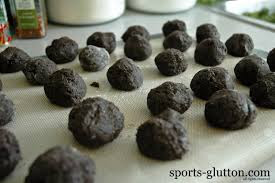
two ingredients. can you guess?

like this:
with extra chunk.

and like this:
coat the two ingredients in another ingredient.

THE TWO (OR THREE) INGREDIENTS

1 package of oreos (whatever kind you prefer, they could ever be nutter butters for all i care, as long as the package is around 16 oz.)

1 package of cream cheese (again, whatever u want–reduced fat, fat free, strawberry swirl, as long as you use 8 oz., or half a pound)

White chocolate or some chocolate in a form that is conducive to melting

DIRECTIONS

TAKE the oreos and crush them. I will not advise you on methodology, but I did it by pushing the cookies into a Ziploc bag and throwing the bag around. Crush to whatever level of crunchiness you prefer.

MIX the crushed oreos with cream cheese. Get that all incorporated.

ROLL the oreo-cream cheese mixture (which we will now call oreo cheesecake) into balls.

***If you like to coat the oreo cheesecake balls in something meltable, like white chocolate, have it melting over the stove in a pot. Once melted, use tooth picks to dip the balls into it. If the balls are too heavy to stay on the toothpick, use a spoon. if your name starts with a K, use your hands.

this is my hand.