Showing posts with label thinking. Show all posts

Sunday, March 27, 2016

i feel like im writing about "pop" psychology but im actually trying to decry it//right and left\\

You're trying to remember something.
lucky for you, this girl is studying memory.
Cognitive and Experimental Psychologists implement two major methods of retrieval when studying memory: Recall and  Recognition. We use these techniques too. For instance, when we're trying to reach back into our minds and resurrect a memory, a detail, the day the music died, we may be able to recall the item explicitly:
THE MUSIC DIED WHEN BUDDY HOLLY DIED ON FEBRUARY 3RD, 1959
seriously, type "what day did the music die" into Google. the search engine is pretty explicit.
If unable to pinpoint a date off the top of our heads, we may need some clues to answer the question. Items related to the main concept in question can lead you to recognize it, locate its trace in your mind eventually. I am totally assuming you know who Buddy Holly is by the way, and I apologize if you don't. I just need a specific fact that is somewhat well-known to roll out here.
So, we mentioned the word "recognize." That's a concept in cognitive psychology. Let's explore it by focusing on processes underlying recognition: re-experience and familiarity.
RECOGNITION by re-experience/recollection brings about feelings of being able to mentally relive the past. 
RECOGNITION by familiarity brings about feelings of being on the edge of knowing something for sure. One can feel clueless as to why the familiar feeling is arising.
Researchers conducting experiments distinguish between these recognition processes by asking participants if they can "remember" the item or word (which indicates recollection), or if they just simply "know" that they saw the item before (which indicates familiarity).
There is EVIDENCE for these different processes underlying recognition from neuroimaging studies:
Recollection shows increased activity in the hippocampus, while familiarity shows increased activity in the parahippocampal and perirhinal cortices. Think of these subprocesses as complementary to explicit recall. The parahippocampal and perirhinal cortices are literally encasing the explicit center:
The hippocampus (G. “seahorse”), the Explicit Center;
The parahippocampal cortex, a complementary structure to the hippocampus, involved in the “where” recognition;
sidenote:
Studies show the parahippocampal gyrus to have a role in recognition of social context as well as environment. Research from a group led by Katherine P. Rankin suggests that the parahippocampal gyrus is responsible for detection of sarcasm. 
You may be wondering: Isn’t the left side of the brain responsible for the understanding of language, and other linear, rule-based processes? As you keep learning about the mind, the more you will realize that the left-brained/right-brained dichotomy is grossly oversimplified. Both hemispheres have their specialties, but what is one side of your body without the other?
Yes, the right parahippocampal gyrus is involved in recognition of visual context, a finding that probably dances on your prior knowledge of right-brained specialization. But, in keeping with its name, there is strong evidence supporting that the parahippocampal gyrus is involved in recognition of paralinguistic elements of conversation (e.g. sarcasm). 
For a refresher on Greek prefixes: ORIGIN from Greek para ‘beside’;
The right parahippocampal gyrus has been shown to be responsible for recognition of environmental context, social context, as well as nuances in language–elements that sit beside language itself. This shows us that hemispheric lateralization is not as left-brained/linear, right-brained/spatial as we thought. While the left brain may be more responsible for following grammatical rules, the right parahippocampal gyrus can aid you in recognizing where those rules bend to take on a meaning other than the literal translation. 

Doesn’t this make splendid sense? The supposedly SPATIAL, weird-super-interpretive hemisphere of your brain aids you in detecting the location of sarcasm. If the left, more linear side of our brain did this, it would have to detect the sarcasm as a thing in each instance it arises. The things, or words, used to create a sarcastic sentence can vary, but the environment around it is what makes it sarcasm.
From this, we could say that sarcasm is not an object; it does not follow linear rules, or translate semantically. The literal meaning is the what. The where, on the other hand, considers where you and your fellow conversationalist are in your lives, in your surroundings, and, ultimately, in your minds. It is these spatial concepts that point to sarcasm rather than define it. 

Bihemispheric elements complement one another in dealing with a supposedly left-brained construction (language), which could not take on the same meaning–no matter how many grammatical rules you lived by–if you didn’t implement your right-brained wisdom.
Article concerning right-brains and sarcasm: http://www.nytimes.com/2008/06/03/health/research/03sarc.html?em&ex=1212724800&en=51b0f096761db2f9&ei=5087+&_r=0

So I didn't quite complete my whole lesson on recognition. I guess I just wanted to explain how subprocesses of memory, such as those facilitated by the parahippocampal gyrus, aid us in retrieving more explicit ones, such as the date February 3rd, 1959. While you tried to remember the day the music died and who I was talking about, this may have helped you (link):

Tuesday, January 19, 2016

all you need is not love.

It was just Martin Luther King Jr. Day weekend, and I felt barraged by promotions of love:


even Dr. King looks afflicted in this one.

There's a problem with this. Love cannot solve everything.

Think about it. If you loved everyone, who would you have to blame? How would you get anything done?

While the above statements are worth consideration, my argument against love is not predicated on a need to blame. But the expectation of love to solve everything–differences, tensions, hard feelings–can lead to serious disappointment. You can't love everyone because the connoted intensity of the feeling would blind you to understanding what those differences, tensions, and feelings are made of.

FOR EXAMPLE, you are in an argument with someone, pitting your beliefs against his or hers. The topic could concern politics, religion, lifestyle. How would love benefit you there? 

I don't agree with you, but I love you, so let's stop arguing.

If someone said this to me, I would think they're using love as an excuse, as a way out of trying to understand what I'm talking about, what I'm thinking about, and maybe why I'm thinking in that way.

Now, here's the first showing of my answer to the dilemma, my remedy for disagreements, personal issues, and social problems: not love, but a will to understand

Consider the following statement, which I've come to hear and see frequently enough to register a maxim, taken from the New Testament of the Bible:

Love thy neighbor as thyself.

Sigmund Freud called the expectation veiled by the easiness of saying–and superficially believing in– the exhortation unrealistic. "Love thy neighbor as thyself," misconstrues human nature, and disregards the individual right to choose who to love, and how.

Freud. 

A lot of social exchanges on the psychoanalyst ultimately denigrate him. Most conversations I've heard about Freud default to his psychosexual theories, depend on terms like "phallic stage" and "penis envy," "Oedipus conflict" and a quick reference to cocaine to discredit his work and, finally, to verbally confirm their lack of sexual interest in their mothers.

But I think that if you think you have to love thy neighbor as thyself, or love a stranger or someone you don't enjoy being around, you will end up hating yourself, doubting your worth as a human, and be bothered by a perceived inability to love.

An interaction will leave you feeling angry. You will become angrier if you deny yourself the right not to love.

"All you need is love" says John Lennon.

Nope.

Message from religion: "Love thy neighbor as thyself"

I hear Freud was pessimistic. In his writings, he does not communicate the sunniest perception of human nature. But he was a psychoanalyst. He tried to understand. YES there are ethical concerns about his practice, but he did not think that love was an answer to the woes of society, or the chasms between people. LOVE is not an guaranteed, pliable answer to every situation. I do not want to love everyone, for that would be EXHAUSTING.

If understanding is step towards love, then, maybe I can try to start.

Monday, December 28, 2015

following directions//oreo cheesecake balls

THE FINAL PHASE OF FOLLOWING DIRECTIONS
                                 by Sarah Simon

okay, a friend of yours has timidly asked to be picked up, and, when you agree, graciously provides an address. you perform some arduous research on GOOGLE, and feel as though its mapping service has done you well: take a left there, swirl in the roundabout, and go straight. oh, and the house number is 47. you'll find it when you get in the area.


the last thought often leads to problems. notice the hypothetical mind's curtailing attention. at the later stages of following directions, attention recedes. 

it's habitual; I see it in me, in others, leading us to the minutes of confusion and stress just before reaching a destination. 

once the first steps of the mapping service have been imprinted, once we've mentally navigated through the major streets and terms, it's satisfying enough; we have met the request to map unfamiliar territory, focused our imagination, and implemented technology for practical use.
47 will show once I get in the area.

WAIT a minute, honey--zoom in. is 47 on some unprecedented diagonal? is it nestled between two larger structures? has it recently been demolished and you're just lying to me because you have a specific paranoia about divulging personal details? the apparent inability to locate a particular address–when you expected easy location once you got in the area–reminds of the quote,


It ain't what you don't know that gets you into trouble. It's what you know for sure that just ain't so.
~~MARK TWAIN

I'm trying to find an everyday comparison–something you plan, but not specifically enough; something you take for highways and main roads but not for the side streets.

WOAH
WOAH
WAIT
STAND STILL


I HAVE THE OPPORTUNITY TO MAKE THIS INTO A METAPHOR FOR LIFE:

***Life: pay attention to the side roads. savor the little things***

no I'm not going to do that           who do you think I am.

~~~~~~~~~~~~~Possible solutions~~~~~~~~~~~

Maybe just zoom in a little more to google maps? or ask your friend for specifics, like restaurants ask for apartment numbers and you say "7D as in Dog." the clarification could prevent the tight grip on the wheel from tautening conversation.

here we go to savoring the side streets. make an oreo cheesecake ball.

made 'em yesterday. literally two ingredients (or three, if you so choose). as i shared with a friend, these treats are "little bites of gratification."

he replied, "instant."

you can make 'em like this:
two ingredients. can you guess?

like this:
with extra chunk.

and like this:
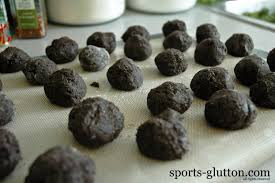
coat the two ingredients in another ingredient.

THE TWO (OR THREE) INGREDIENTS

1 package of oreos (whatever kind you prefer, they could ever be nutter butters for all i care, as long as the package is around 16 oz.)

1 package of cream cheese (again, whatever u want–reduced fat, fat free, strawberry swirl, as long as you use 8 oz., or half a pound)

White chocolate or some chocolate in a form that is conducive to melting

DIRECTIONS

TAKE the oreos and crush them. I will not advise you on methodology, but I did it by pushing the cookies into a Ziploc bag and throwing the bag around. Crush to whatever level of crunchiness you prefer.

MIX the crushed oreos with cream cheese. Get that all incorporated.

ROLL the oreo-cream cheese mixture (which we will now call oreo cheesecake) into balls.

***If you like to coat the oreo cheesecake balls in something meltable, like white chocolate, have it melting over the stove in a pot. Once melted, use tooth picks to dip the balls into it. If the balls are too heavy to stay on the toothpick, use a spoon. if your name starts with a K, use your hands.

this is my hand.