Monday, December 28, 2015

following directions//oreo cheesecake balls

THE FINAL PHASE OF FOLLOWING DIRECTIONS
                                 by Sarah Simon

okay, a friend of yours has timidly asked to be picked up, and, when you agree, graciously provides an address. you perform some arduous research on GOOGLE, and feel as though its mapping service has done you well: take a left there, swirl in the roundabout, and go straight. oh, and the house number is 47. you'll find it when you get in the area.


the last thought often leads to problems. notice the hypothetical mind's curtailing attention. at the later stages of following directions, attention recedes. 

it's habitual; I see it in me, in others, leading us to the minutes of confusion and stress just before reaching a destination. 

once the first steps of the mapping service have been imprinted, once we've mentally navigated through the major streets and terms, it's satisfying enough; we have met the request to map unfamiliar territory, focused our imagination, and implemented technology for practical use.
47 will show once I get in the area.

WAIT a minute, honey--zoom in. is 47 on some unprecedented diagonal? is it nestled between two larger structures? has it recently been demolished and you're just lying to me because you have a specific paranoia about divulging personal details? the apparent inability to locate a particular address–when you expected easy location once you got in the area–reminds of the quote,


It ain't what you don't know that gets you into trouble. It's what you know for sure that just ain't so.
~~MARK TWAIN

I'm trying to find an everyday comparison–something you plan, but not specifically enough; something you take for highways and main roads but not for the side streets.

WOAH
WOAH
WAIT
STAND STILL


I HAVE THE OPPORTUNITY TO MAKE THIS INTO A METAPHOR FOR LIFE:

***Life: pay attention to the side roads. savor the little things***

no I'm not going to do that           who do you think I am.

~~~~~~~~~~~~~Possible solutions~~~~~~~~~~~

Maybe just zoom in a little more to google maps? or ask your friend for specifics, like restaurants ask for apartment numbers and you say "7D as in Dog." the clarification could prevent the tight grip on the wheel from tautening conversation.

here we go to savoring the side streets. make an oreo cheesecake ball.

made 'em yesterday. literally two ingredients (or three, if you so choose). as i shared with a friend, these treats are "little bites of gratification."

he replied, "instant."

you can make 'em like this:
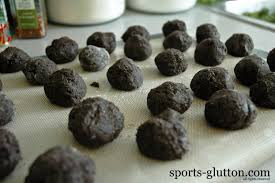
two ingredients. can you guess?

like this:
with extra chunk.

and like this:
coat the two ingredients in another ingredient.

THE TWO (OR THREE) INGREDIENTS

1 package of oreos (whatever kind you prefer, they could ever be nutter butters for all i care, as long as the package is around 16 oz.)

1 package of cream cheese (again, whatever u want–reduced fat, fat free, strawberry swirl, as long as you use 8 oz., or half a pound)

White chocolate or some chocolate in a form that is conducive to melting

DIRECTIONS

TAKE the oreos and crush them. I will not advise you on methodology, but I did it by pushing the cookies into a Ziploc bag and throwing the bag around. Crush to whatever level of crunchiness you prefer.

MIX the crushed oreos with cream cheese. Get that all incorporated.

ROLL the oreo-cream cheese mixture (which we will now call oreo cheesecake) into balls.

***If you like to coat the oreo cheesecake balls in something meltable, like white chocolate, have it melting over the stove in a pot. Once melted, use tooth picks to dip the balls into it. If the balls are too heavy to stay on the toothpick, use a spoon. if your name starts with a K, use your hands.

this is my hand.

Monday, December 14, 2015

10% are using android//study music//this is still a food blog

FROM LE STATS:

"Sarah Simon, 10% of people who visit your blog are using their Android."


It's almost the end of the semester. More visibility is given to people studying than any other time in the year. Everyone seems on that quest for FOCUS--a front lobe-dopamine wave.

Need study music? Here's a mix, recorded at your local library:


https://soundcloud.com/ssimon8/sets/enlim

P.S. "Enlim" is an intentional, SUNY-Geneseo-centric name.

P.P.S. a mix from the QUIET SECTION coming soon...


this is still a food blog.

Tuesday, December 8, 2015

one-liners//this is a food blog again

I've been dipping into old notes I wrote on my phone...some of them seem pretty insightful and o.k. i think of how "young" I was at a time stamp of two years ago. but if i didnt know anything about who wrote these notes, I wouldn't feel a temporal connection:

(I am pairing these with pictures of food because I want this to become a food blog again.
More culinary efforts to come.)


why do i feel the need to peruse your daily
hourly
minutely posts when I
have Maya Angelou right next to me


Mediocre fried chicken and decaf Americano.


at night, she blocks the time box~


reverberating through a light wooden headboard


To John Belushi,


this library is like a stuffy nose.


a pound is 454 grams


lemons

Wednesday, November 25, 2015

Norman's is not the Normal//Thanksgiving

Norman Rockwell's family meal painting is sometimes know as Norman Rockwell's Thanksgiving.


But he called it Freedom from Want, as part of a four oil painting series based on Franklin D. Roosevelt's 1941 State of the Union Address (aka The Four Freedoms Speech):


Norman Rockwell (1894-1978) is regarded as one of the most prominent painters in 20th century United States. His works tend to reflect American consumerism, culture, as well as social tensions:

The Problem We All Live With, 1964


If you have a mental picture of 1950s, it is probably oiled over by Norman Rockwell's work.
He worked for the Saturday Evening Post, one of the most widely circulated publications among the American middle class from the 20s to the 60s–the trunk of the 20th century.


Rockwell's art was so popular with the American people that newsstand sales of The Saturday Evening Post would increase by 50,000 to 75,000 copies every time his art appeared on the cover. <-----(thanks)

ALSO, Rockwell had a 64-year relationship with the Boy Scouts of America, for which he worked as a staff artist with Boys' Life Magazine. He was promoted to magazine arts' editor when he was only 19.


and some more Rockwell:


We're coming full circle: Which is your favorite farce/recreation/adjusted for inflation:

http://humor.gunaxin.com/rockwells-thanksgiving-parodies/178165

(im making you copy and paste it into your browser yes)


unless u click hur


Saturday, November 21, 2015

ANIME//body positions\\mannerisms


EMBODIED COGNITION: 
a growing research program in cognitive science that emphasizes the formative role the environment plays in the development of cognitive processes.

that's the first response from google. 
Let's review the concept while lying comfy with a cherished ***anime***
        
Introduction to Embodied Cognition Through Media
         Death Note, a Japanese manga series that has gained popularity for its anime adaptation, follows a young boy who seeks to better the world (VIZ, 2014).  From manga to television set, audiences watch as the boy, Light Yagami, attempts to cleanse the social landscape of evil with the help of a death note, or supernatural notebook, that allows the holder to kill any known person whose name he or she transcribes. 
         From a rating pool of 530,473 who watch the Death Note anime, the show scores an 8.75 out of 10 (myanimelist.net).  The high rating lends to media success through synergistic media deals.  The stories and iconography of the anime echo those of the original manga edition, from author Tsugumi Ohba and artist Takeshi Obata.  What occupies the minds of forum fans, however, is not Ohba’s moral dilemmas, or Light’s questionable heroism; instead, they ask, why does L, another character, squat “when he can jolly well just sit?” (Minitokyo.net).
         Figure 1 shows a freeze frame of L in his characteristic stance.  He is crouched over with both feet flat on the armchair, facing a porcelain tea set.  Forum users suggest explanations for his behavior: he thinks he is so “special that he can’t do what normal people do”; “he probably sat like that as a child and it’s a habit he can’t get rid of”; “his intellect will drop by 40% if he sits normally.”  Later posts do in fact corroborate the statistic; Ohba’s manga notes that if L were to sit “normally,” with both feet flat on the ground, his concentration power would drop. 
         Authors and artists often create behavior specific to characters.  The Big Bang Theory’s Sheldon Cooper dons comic t-shirts and a gawky stance; Orange Is The New Black’s Galina “Red” Reznikov maintains her hair a dyed bright red; Family Matters’ Steve Urkel stands wide-legged with pelvis forward and walks, as another character describes, “like you still have the hanger in your shirt” (phantomflapjack, 2009).  The behaviors are specific to the characters and play a role in defining their personas.  As a forum user writes of L, “it won’t be normal for a weird guy to sit properly” (Minitokyo.net).
         Media representations are planned and purposeful.  They form cameos that come to affect character relationships.  In the untelevised social word, social presentations can be just as specific to an individual as the “hanger” walk is to Urkel.  Likewise, psychological state can be as conditional on behavior as L’s mental prowess is on his squatting.

         Visual culture reflects everyday human understanding (Greysen & Chretien, 2010; Van Cleave, 2010).  Interpretation of one’s social world is ongoing, as is research in the field of social psychology.  By shifting study from the observable world to the body, social phenomena and issues can be understood differently.  Theories of “embodied cognition” postulate social thinking, influence, and relation as originating within the body and being maintained through bodily interpretation and action.   The emerging literature interprets social life as emanating from an organism, rather than from the surrounding world.

Sunday, November 15, 2015

oh. so you need your coffee in the morning//well, maybe you really do.

BEFORE I IMPLANT my arduously-researched two paragraphs about psychological dependencies on coffee, let's gorge:

classic.

look at that angle.

I'm LinkedIn.

ooh, switching it up now.

that's it.

okay, guy.

"you take cream, but that's okay."

Now, a sentimental account of your psychological dependence on coffee:

Another study followed 83 college students across two days to see if physical experience facilitated explicit memory recall (Kelemen & Creeley, 2003).  All participants were asked to drink a beverage before studying 40 pairs of words, with about half being given a caffeinated beverage and the remaining participants a placebo (Kelemen & Creeley, 2003).  Participants were also given one of the two beverages the next day, right before a an assessment testing memory of the words studied the day prior (Kelemen & Creeley, 2003).  Data showed that those who were given the same beverages, caffeinated or not, on both days recalled more word pairs than those who drank different beverages between days (Kelemen & Creeley, 2003).  
         
This study suggests that the ability to perform a task is influenced by the completion of tasks associated with it.  Despite societal beliefs and jests surrounding caffeine in the United States–that coffee enhances mental ability at no effort of the consumer–a “need” for coffee may be created through more than a chemical dependence.  The act of drinking coffee in the morning may enhance the individual’s apparent cognitive ability by simply fulfilling the necessitation of routine.  Ironically, modular views are aided by the perception of the mind as independent of the body–that is, unless a foreign substance is introduced.  Here, embodied cognition triumphs the mind over the body. 

*******the above was extracted from Sarah Simon's term paper